
Salvation Mountain
A beacon of Devotion and Desert Magic

Let me begin by saying this story is incomplete.
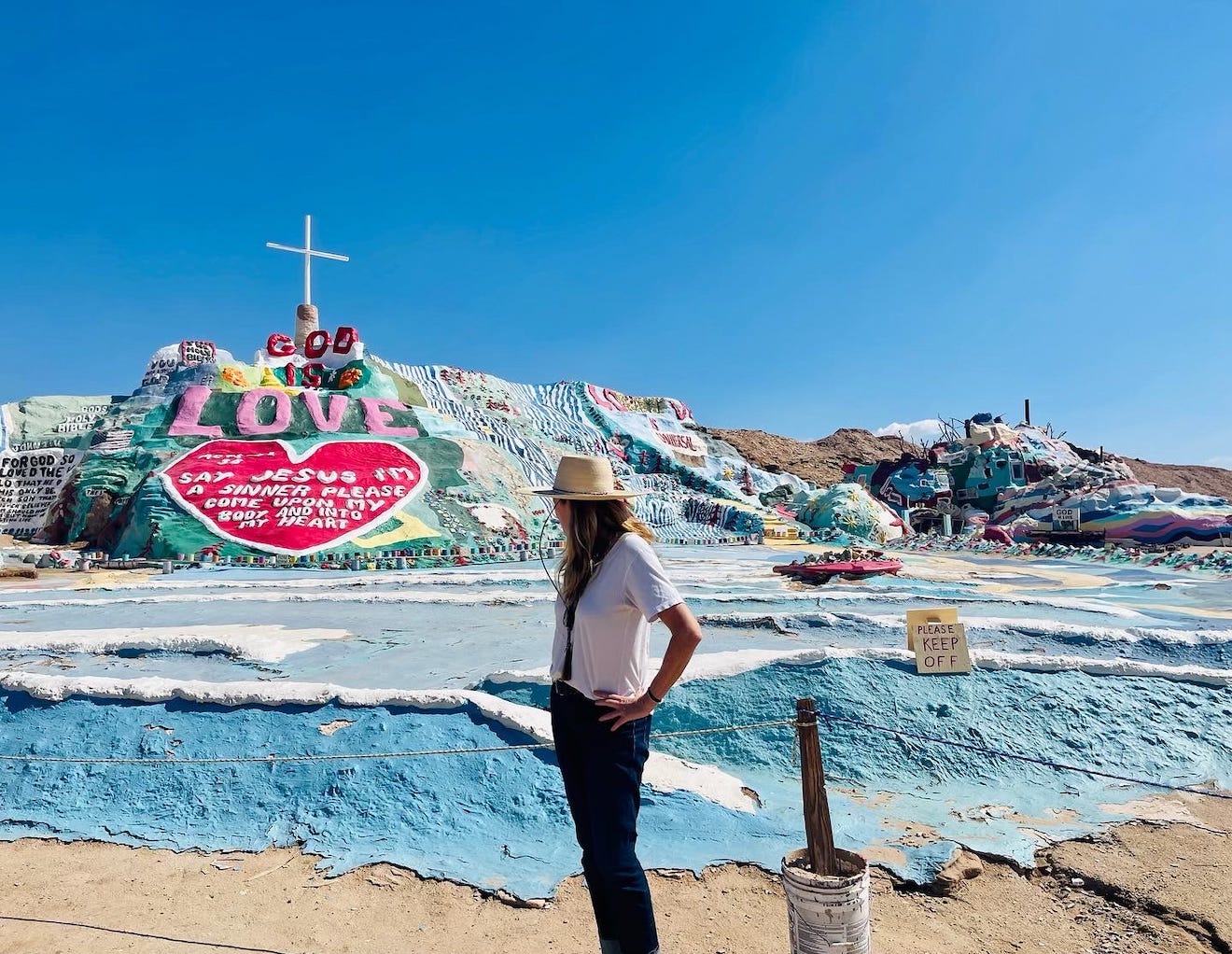
Since my first visit to Salvation Mountain three years ago, access to the property has become more readily available. I’ve made several attempts to return for a deeper, more complete experience to share here—but life, as it does, got in the way, preventing my return. Eventually I realized my desire to share this magical place couldn’t wait any longer. Like the mountain itself, this post may be incomplete in its fullest representation—but the incompleteness leaves room for your own experience, should you ever find yourself standing at the foot of Salvation Mountain.
Ideally, I should call this post “Bombay Beach Part 2” an extension of my last substack, as the proximity and energetic continuity between Bombay Beach and Salvation Mountain is impossible to ignore.
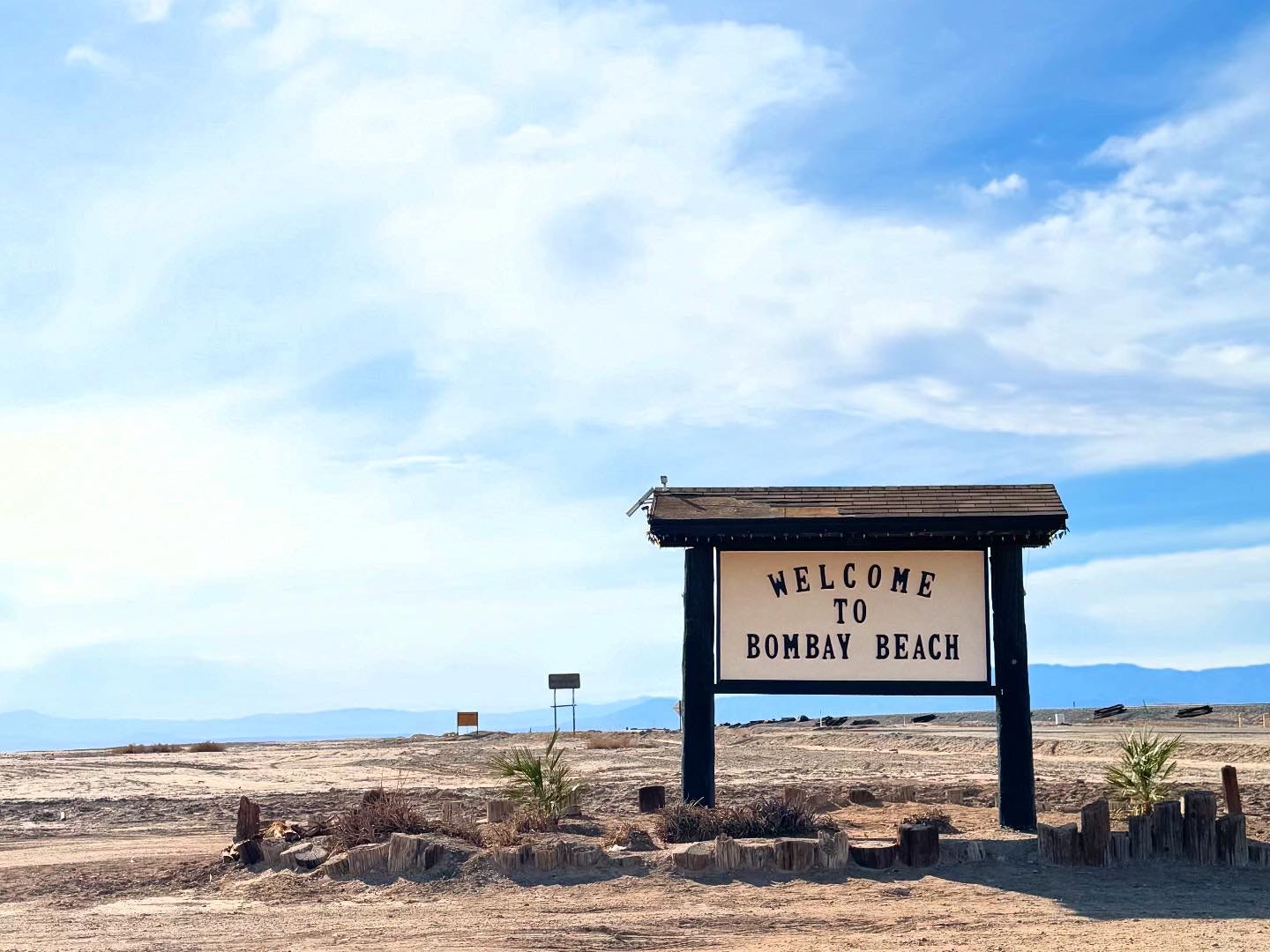
While Bombay Beach is an entire town and Salvation Mountain a singular monument, both destinations are built on a kind of revivalist foundation, exuding hope and resilience (qualities we seem in dire need of these days). Where the two diverge, however, is the throughline of their respective histories, evolutions, and present-day existence.
I first visited Salvation Mountain with my dear friend Suné back in 2022. It was our first stop after leaving Los Angeles—an appetizer to a much bigger, insatiable appetite for the adventure that lay ahead.
About an hour and a half east of Palm Springs on the 10 freeway, we arrived in the desolate landscape located just past the Salton Sea, in the small unincorporated town of Niland, California.
Here, you’re immediately struck by the almost blindingly vibrant colors of this man-made mountain—a beacon rising from the rubble and debris of foraged art supplies strewn across the compound. The site is interwoven with desert shrubs and anchored by a seemingly abandoned truck, which I learned had been the home to the mountain’s creator for 27 years.
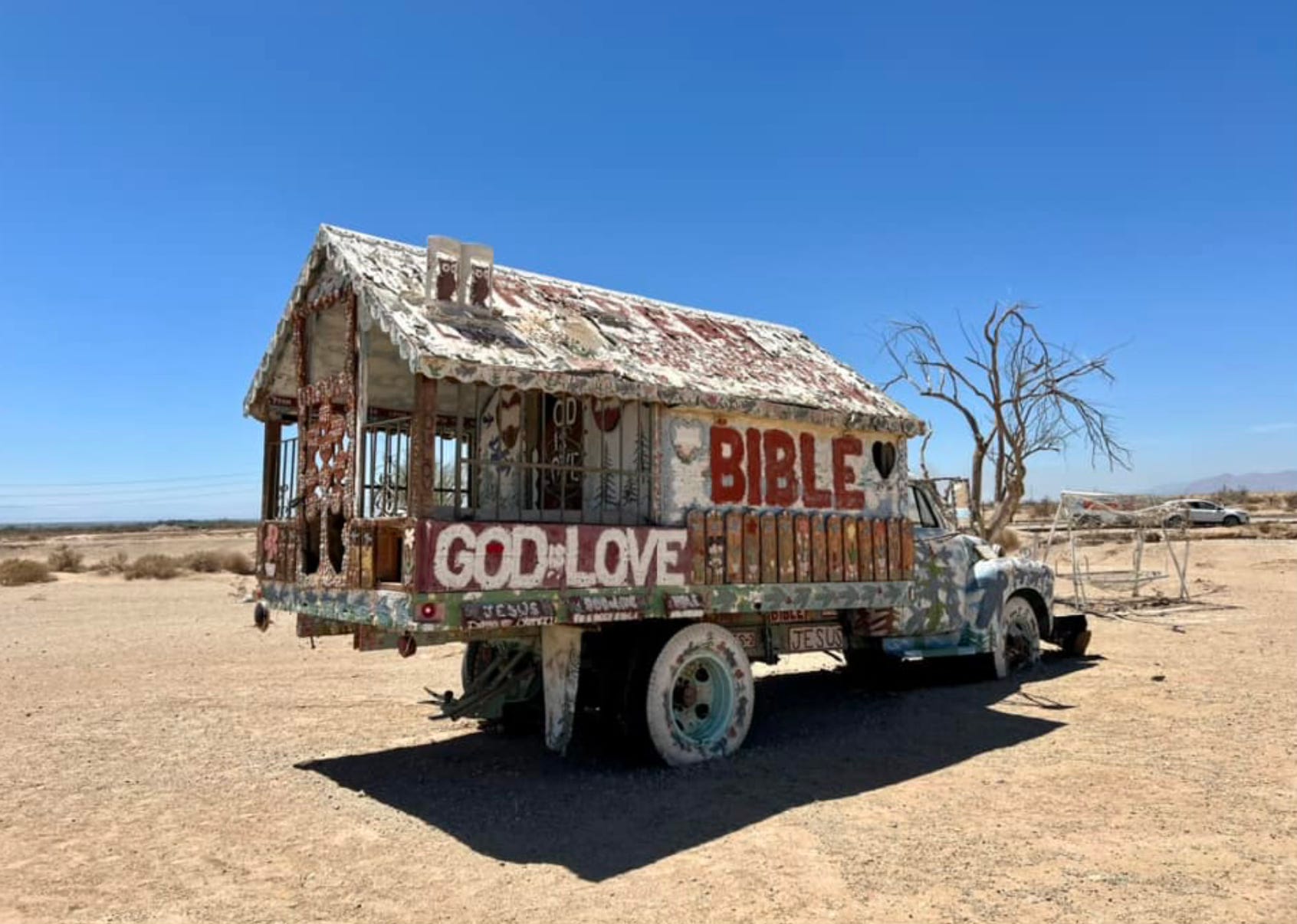
At the time of our visit, parts of Salvation Mountain were closed off due to damage from extreme weather and safety concerns. (Note: These restrictions have since been lifted. With proper timing and the support of volunteers, visitors can now access the site more intimately, including a walk along the famed “yellow brick road.”)
Leonard Knight, the creator of Salvation Mountain
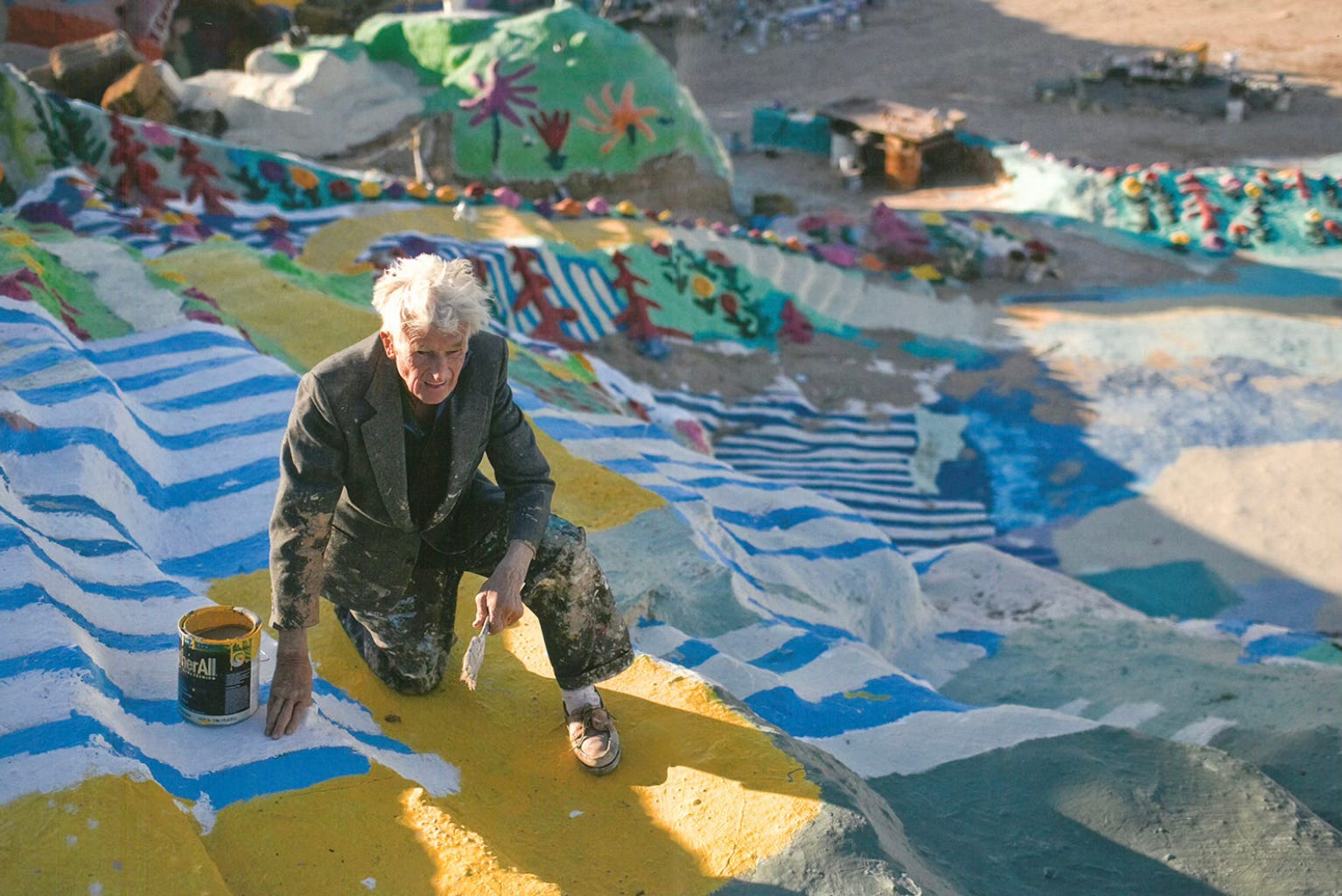
The story of Salvation Mountain is a patchwork of lived experiences—a true embodiment of the structure itself, built with little more than one man’s hands and heart.
Leonard Knight, aka the “California Drifter” was a deeply religious man whose personal mission was to spread the word of God through his universal message of “God is Love.” Whoever your “God” might be, the sentiment was one of inclusion and devotion.
Born in 1931 in a small town just outside of Burlington, Vermont, Leonard spent his early years working on his family’s 32-acre farm and attending a one-room schoolhouse. Those humble beginnings remained a grounding influence throughout his life—a life guided by simplicity, hard work and deep faith.
In 1956, after receiving an honorable discharge from the Army, Leonard set off with his brother on a summer-long road trip to California (a man after my own heart, haha). This journey marked a quiet yet powerful turning point—a spark that ignited the a life devoted to purpose.
"The year 1967 found Leonard back in San Diego visiting his sister Irene. She was always talking about the Lord and it sort of bothered Leonard. One morning, to escape her sermonizing, Leonard went out of the house to sit in his van. To this day he really doesn’t know why, but he started repeating The Sinners Prayer - “Jesus, I’m a sinner, please come upon my body and into my heart.” It was on that Wednesday….at 10:30 in the morning…in his van…at the age of 35…he accepted Jesus into his heart and he hasn’t been the same ever since.”
And so began his journey as an “evangelist” to spread the word of “God’s Love” as far and wide as he possibly could.
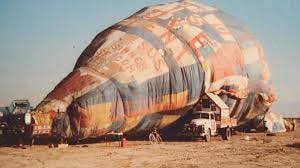
His first attempt at spreading the word of God came in the form of a handmade hot air balloon, a project he would continue working on for 14 years. With fabric scraps, a donated sewing machine, and sheer perseverance, he envisioned sending his message high into the sky. But after countless failed launches, he eventually let the dream go.
“All he had to show for his efforts was an endless sea of rotted-out fabric colors spread at his feet across the desert landscape.”
The First Mountain
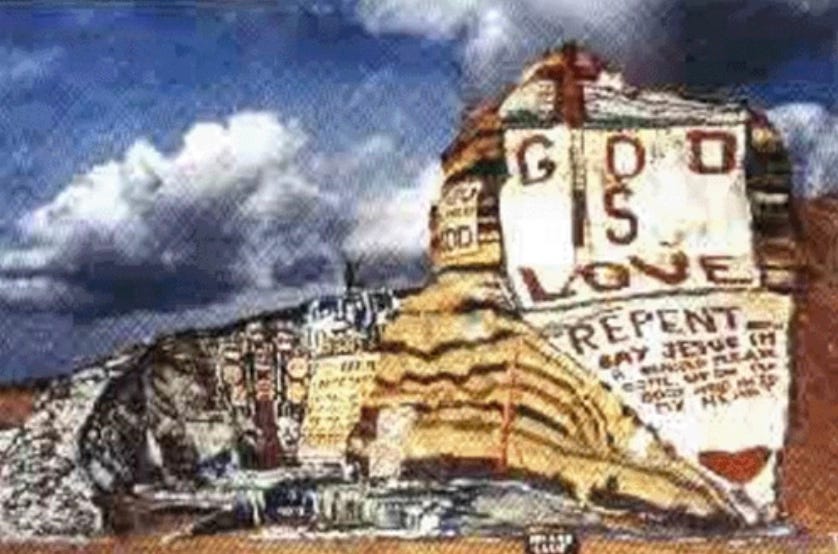
Still determined, Leonard gave himself one final week in the desert to reflect and regroup. He had a single bag of cement, which he used to make what he called a “small statement.” That modest beginning soon grew as he started adding junk tires and foraged materials from nearby dumps. What was meant to last a week turned into months—then years—as the scale of the mountain expanded along with Leonard’s vision.
He didn’t know about Adobe building at the time, and after 3 years of his scrappy, make-shift building technique, the first mountain literally collapsed on him.
“Well everybody thought I’d be discouraged and that ‘God must not want you to put the mountain up.’ But my thought was, ‘Thank God, for taking the mountain down. Nobody got hurt. And I just looked up and said, ‘God, I’m gonna have to do it again. But this time with more smarts.” - Leonard Knight
The 2nd Mountain - Salvation Mountain
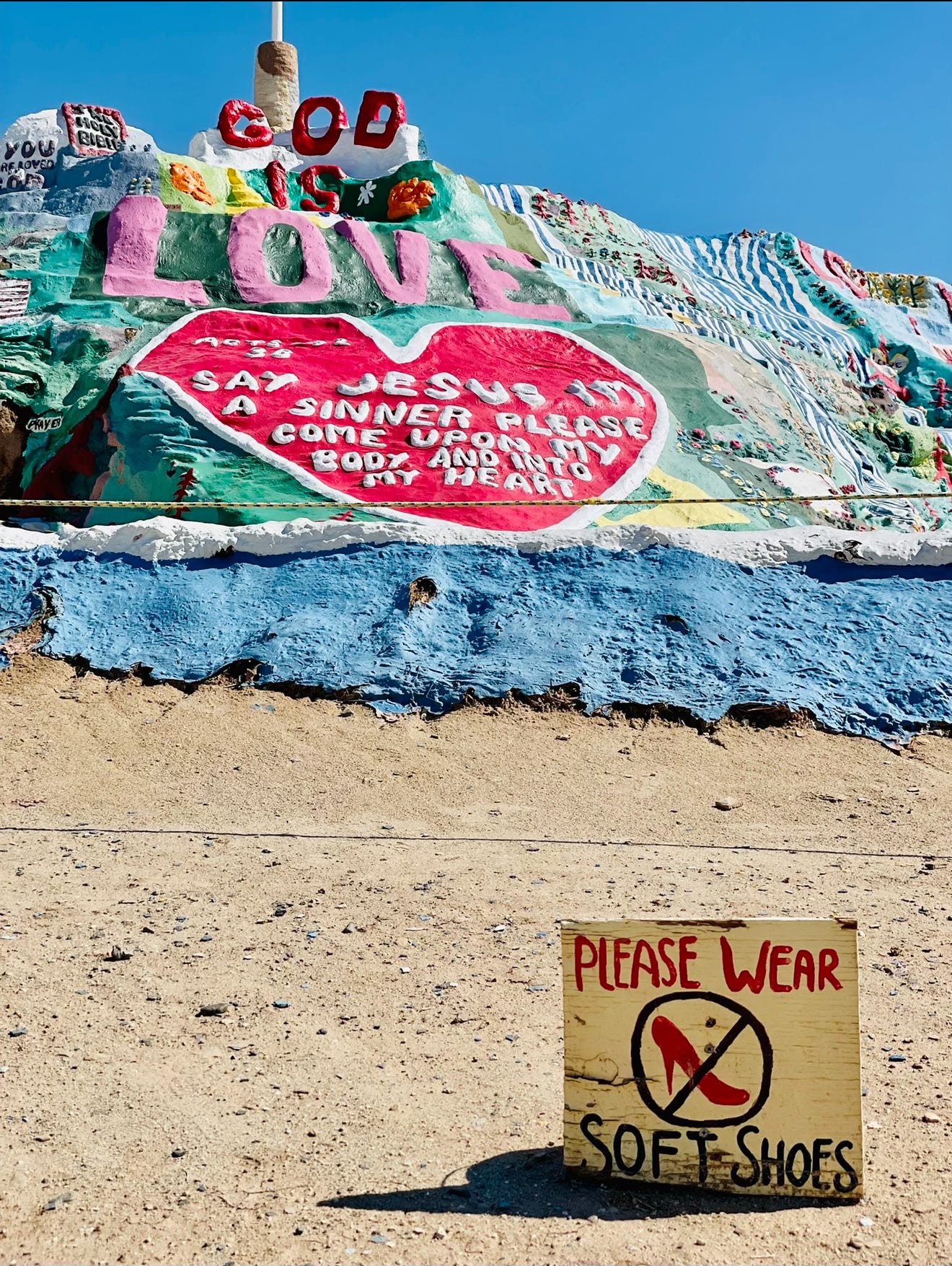
This is where the real work began.
Leonard transitioned to adobe clay mixed with straw, learning the process as he went. He mixed and built nearly everything by hand. Donations came in the form of lead-free paint—and what he called “compliments and friendliness.”
The mountain was a true labor of love. As each new section was completed, Leonard would immediately coat it with paint to protect it from erosion and desert elements. In some areas, it’s believed there are more than ten layers of paint—creating a vibrant shield over the hand-crafted landscape.
“If I want to make a flower, I just make it with adobe and let the sun bake it. And there’s the flower. And then I put a little leaf on it. And there it is. And that’s how the mountain was built.” - Leonard Knight.
Leonard Knight stopped actively working on Salvation Mountain in 2011 due to declining health at the age of 79.
He passed away on February 10, 2014, at the age of 82.
After he stepped back, Salvation Mountain, Inc. —a nonprofit formed by devoted volunteers—took over the preservation of the site, carrying forward his legacy and keeping it accessible to visitors from sunrise to sunset, 365 days a year. This ongoing care stands as a living testament to his enduring message: “God is Love.”
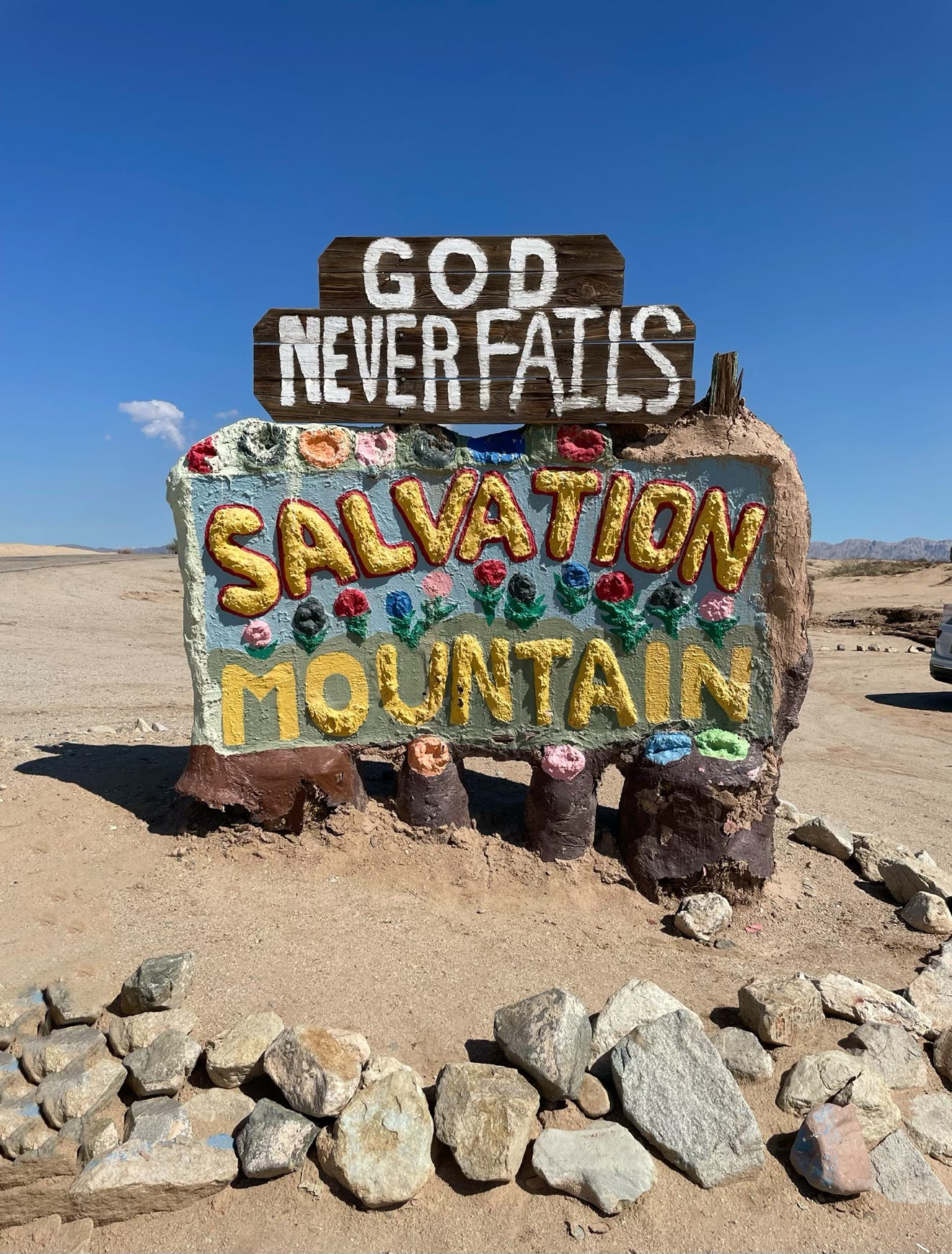
Visiting Salvation Mountain today: what you should know before you go.
Salvation Mountain is a powerful fusion of art, faith and grassroots preservation in one of California’s wildest deserts. Be mindful of the heat when you visit, and bring water, a hat and an open mind. There’s nothing quite like this place.
Location and Hours
Located on Beal Rd, Niland, CA near Slab City, about 90 minutes east of Palm Springs by the Salton Sea.
Open daily from sunrise to sunset, year round, free of charge, but donations are welcome and accepted.
To learn more about donations and visitations
salvationmountain.org
Thank you
Far out!
Cool story and I like your writing style
Saludos!